
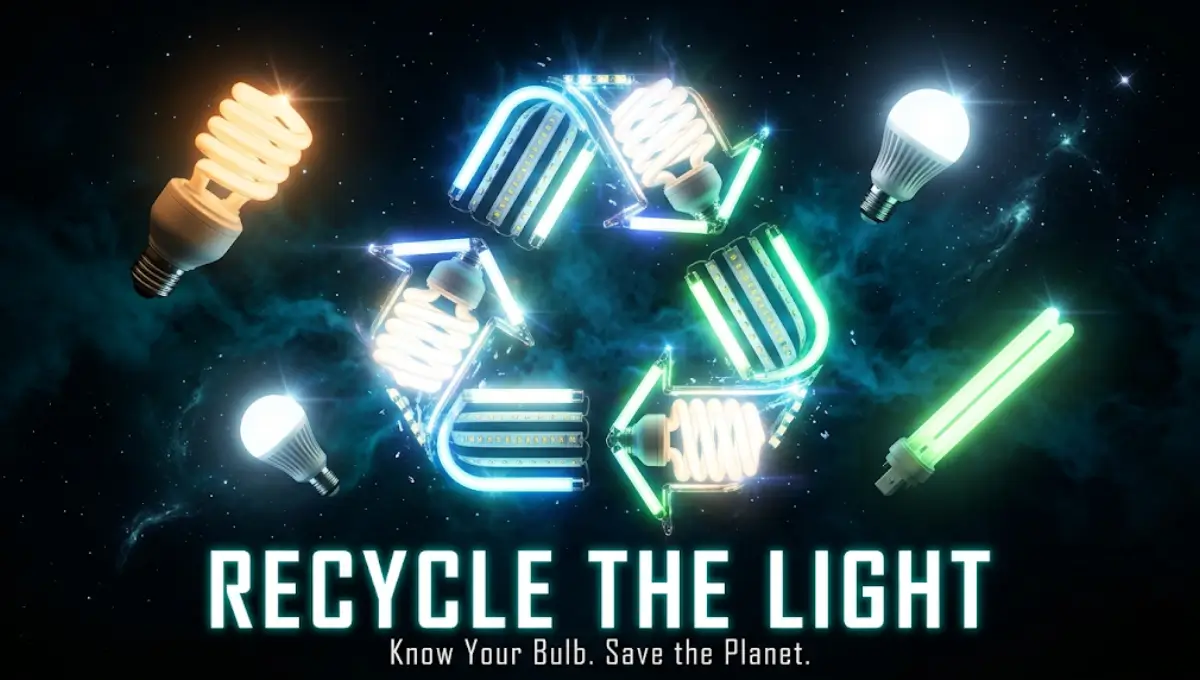
Yes, you can recycle light bulbs — but the right method depends on the type of bulb you have.
Many bulbs, especially CFLs and fluorescent tubes, contain mercury and other hazardous materials that can contaminate soil and groundwater if thrown in the trash.
The U.S. EPA recommends using retailer take-back programs, certified recyclers, and local hazardous waste collection events to dispose of bulbs safely.
What this guide covers:
- Which bulb types must be recycled vs. which can go in the trash
- Step-by-step recycling instructions for CFLs, LEDs, fluorescent tubes, incandescents, and halogens
- Where to drop off or mail in used bulbs (free and paid options)
- What is allowed vs. not allowed by type
- The EPA’s official protocol for cleaning up a broken CFL
- Common mistakes people make — and how to avoid them
- The latest 2025–2026 state bans and policy updates
Clear Answer to the Question: Can You Recycle Light Bulbs?
Yes — but not all bulbs recycle the same way.
The method and urgency depend on the bulb type:
- CFL bulbs — Must be recycled. They contain mercury. (EPA)
- Fluorescent tubes (T5, T8, T12) — Must be recycled. They contain mercury and are classified as universal waste under federal law. (EPA)
- LED bulbs — Should be recycled. They contain circuit boards, metals, and trace hazardous materials. (Philips Hue)
- Incandescent bulbs — Can go in regular trash (non-hazardous), but recycling is preferred. (USPS Universal Waste Reminder, Oct 2025)
- Halogen bulbs — Can go in regular trash. Wrap in original packaging before disposal.
Key Facts & Explanation
Why does it matter?
CFLs contain an average of less than 4 milligrams of mercury per bulb — roughly the amount that would cover the tip of a ballpoint pen. While small, mercury is highly toxic and can contaminate air, water, and soil if CFLs break in landfills or incinerators. (EPA)
Under U.S. federal law (EPA, 40 CFR Part 273), fluorescent tubes are classified as universal waste, meaning commercial and industrial users are generally required by law to recycle them rather than throw them away. (EPA)
As of 2025–2026, multiple U.S. states have also enacted bans on the sale of fluorescent lamps, accelerating the shift to LEDs and increasing the volume of old fluorescent bulbs entering the recycling stream. (PEC NW State Fluorescent Ban Tracker, March 2026)
Types / Categories: Bulb-by-Bulb Recycling Guide
CFL Bulbs (Compact Fluorescent Lamps)
CFLs are the most urgently regulated bulb type for households because of their mercury content.
How to recycle CFLs:
- Drop off for free at Home Depot (recycling bins near the store entrance). (Home Depot)
- Drop off for free at Lowe’s (permanent bins near store entrance).
- Drop off for free at IKEA (usually near Customer Service).
- Use the Earth911 recycling locator at search.Earth911.com — enter your zip code to find local options.
- Purchase a mail-in recycling kit such as RecyclePak by Veolia (recycleabulb.veoliaes.com) or EasyPak by TerraCycle (tcrwusa.com).
- Check with your local municipal household hazardous waste (HHW) program for free drop-off events — call 1(800)CLEANUP or visit your city/county website.
Fluorescent Tubes (Linear Fluorescent Lamps — T5, T8, T12)
Linear fluorescent lamps are classified as universal waste under federal law and must be recycled.
How to recycle fluorescent tubes:
- Find a certified commercial lamp recycler via LampRecycle.org (sponsored by NEMA, the National Electrical Manufacturers Association): lamprecycle.org or call 1-855-63-CYCLE.
- Use commercial pickup programs or prepaid recycling kits from providers like Veolia (RecyclePak) or AirCycle (Bulb Eater).
- Contact local hazardous waste facilities or municipal special waste programs.
Proper business storage (required by law):
- Store used lamps in structurally sound, closed containers (cardboard boxes, fiber drums).
- Label containers clearly as “Universal Waste Lamps” or “Waste Lamps” with the accumulation start date.
- Universal waste has a one-year time limit for on-site accumulation before it must be sent for recycling. (EPA)
LED Bulbs
LEDs do not contain mercury, but they do include electronic components, circuit boards, semiconductors, copper, aluminum, glass, and trace metals such as gallium and indium. Some may also contain trace amounts of lead or arsenic.
How to recycle LEDs:
- Drop off at Home Depot, Lowe’s, or IKEA (programs vary by location — call ahead to confirm).
- Use Earth911’s Recycling Locator — search “LED” + your zip code at search.earth911.com.
- Drop off at e-waste recycling facilities, as many accept LEDs alongside other electronics.
- Check with your local public works or sanitation department for scheduled LED/e-waste collection events.
- Smart LED bulbs (Wi-Fi/Bluetooth enabled, such as Philips Hue) must go to designated electronics recycling points, not general waste. (Philips Hue)
Incandescent Bulbs
Incandescent bulbs do not contain mercury or other hazardous materials and are generally not classified as hazardous waste. They can be placed in regular household trash in most jurisdictions. (USPS)
Best practice:
- Wrap the bulb in its original packaging or newspaper before placing in trash to prevent glass breakage.
- Note: As of July 2023, the U.S. federal government banned the manufacture and sale of most inefficient incandescent bulbs, so they are no longer available from most U.S. retailers.
Halogen Bulbs
Halogen bulbs are made with thicker glass and do not contain mercury. They are non-hazardous and may be disposed of in regular household trash.
Best practice:
- Place the spent halogen bulb back into the packaging of the replacement bulb, then dispose of in trash.
- Halogen bulbs are difficult to recycle and are not generally accepted by standard recycling programs.
Where to Recycle: Confirmed Drop-Off & Mail-In Channels
| Channel | Bulbs Accepted | Cost | How to Find |
|---|---|---|---|
| Home Depot (U.S.) | CFLs | Free | Any Home Depot store |
| Lowe’s (U.S.) | CFLs | Free | Near store entrance |
| IKEA (U.S./Global) | CFLs, low-energy bulbs | Free | Near Customer Service |
| Earth911 Locator | CFLs, LEDs, fluorescents | Varies | search.Earth911.com |
| LampRecycle.org | Mercury-containing lamps (commercial) | Varies | lamprecycle.org / 1-855-63-CYCLE |
| RecyclePak (Veolia) | CFLs, LEDs, fluorescent tubes, ballasts | Paid kit | recycleabulb.veoliaes.com |
| EasyPak (TerraCycle) | Lamps, LEDs, batteries, e-waste | Paid kit | tcrwusa.com |
| Municipal HHW Programs | CFLs, fluorescents | Usually free | City/county website or 1(800)CLEANUP |
| Cleanlites Recycling | All lamp types (USPS partner) | Varies | Via USPS eBuy Plus |
What Is Allowed vs. Not Allowed
| Action | CFL / Fluorescent | LED | Incandescent / Halogen |
|---|---|---|---|
| Regular household trash | ❌ Not allowed (most states) | ⚠️ Not recommended | ✅ Allowed |
| Curbside recycling bin | ❌ Not allowed | ❌ Not typically accepted | ❌ Not typically accepted |
| Landfill disposal | ❌ Banned in 6+ states | ⚠️ Not recommended | ✅ Generally allowed |
| Retail drop-off | ✅ Home Depot, Lowe’s, IKEA | ✅ Select stores (call first) | ⚠️ Limited options |
| Mail-in recycling kit | ✅ Yes (RecyclePak, EasyPak) | ✅ Yes | ⚠️ Limited |
| Incinerator | ❌ Never | ❌ Never | ⚠️ Not recommended |
| Vacuuming broken pieces | ❌ Never — spreads mercury | N/A | ✅ OK |
Sources: EPA, USPS Oct 2025
Best Practices
Following these simple steps keeps you compliant and protects the environment:
- Always identify your bulb type before deciding how to dispose of it.
- Never throw CFLs or fluorescent tubes in regular household trash or curbside recycling bins.
- Use Earth911.com or call 1(800)CLEANUP to find recycling locations near you.
- Keep bulbs intact — broken lamps are harder to recycle safely and may release mercury.
- Businesses: Store waste lamps in closed, labeled containers and arrange recycling within one year.
- Call ahead to retailers (Home Depot, Lowe’s, IKEA) to confirm their current bulb recycling programs before visiting.
- Use certified recyclers — look for ALMR (Association of Lighting and Mercury Recyclers) members via lamprecycle.org.
- For households without local options, mail-in kits (RecyclePak, EasyPak) are a compliant solution.
EPA Official Protocol: Broken CFL Cleanup
If a CFL or fluorescent bulb breaks in your home, follow these steps from the U.S. EPA. (EPA Broken CFL Cleanup Guide)
Before cleanup:
- Have all people and pets leave the room immediately.
- Open a window or door and air out the room for 5–10 minutes.
- Shut off any central forced-air heating or air-conditioning system.
During cleanup:
- DO NOT VACUUM — vacuuming spreads mercury-containing powder and mercury vapor.
- Scoop up glass fragments and powder using stiff paper or cardboard.
- Use sticky tape (e.g., duct tape) to pick up remaining small glass fragments.
- Use damp paper towels or disposable wet wipes for hard surfaces.
- Place all cleanup materials in a glass jar with a metal lid or a sealable plastic bag.
After cleanup:
- Place all debris and cleanup materials in a container outdoors until disposed of properly.
- Bring the broken bulb to an official hazardous waste facility — do not place in regular trash.
- Continue ventilating the room for several hours.
Common Mistakes & Misconceptions
| Mistake | Correct Practice |
|---|---|
| Throwing CFLs or fluorescent tubes in regular trash | Take to a recycling drop-off or HHW collection event |
| Vacuuming broken CFL fragments | Use tape and damp towels; air out the room first |
| Assuming all bulbs recycle the same way | Each bulb type has unique requirements — see guide above |
| Believing LEDs are completely safe to trash | LEDs contain metals and electronics; recycle at e-waste centers |
| Mixing used lamps with general waste (businesses) | Store and label separately under the Universal Waste Rule |
| Expecting curbside bins to accept any bulbs | Most curbside programs do not accept any type of light bulb |
| Sending broken lamps in unlabeled containers | Containers must be labeled “Universal Waste Lamps” with accumulation date |
Source: EPA Universal Waste
Recent Updates: 2025–2026
State-Level Fluorescent Lamp Sales Bans
A major policy shift is underway, with multiple states banning the sale of fluorescent lamps entirely to accelerate the transition to LEDs: (PEC NW State Ban Tracker, March 2026)
| State | CFL Ban Date | Linear Fluorescent Ban Date |
|---|---|---|
| California | Jan 1, 2024 / Jan 1, 2025 (pin-base) | Jan 1, 2025 |
| Oregon | Jan 1, 2024 / Jan 1, 2025 (pin-base) | Jan 1, 2025 |
| Colorado | Jan 1, 2025 | Jan 1, 2025 |
| Vermont | Active | Active (4-ft lamps) |
| Rhode Island | 2024 / Jan 1, 2025 (pin-base) | Jan 1, 2025 |
| Minnesota | Jan 1, 2025 / Jan 1, 2026 (pin-base) | Jan 1, 2026 |
| Hawaii | Jan 1, 2025 / Jan 1, 2026 (pin-base) | Jan 1, 2026 |
| Illinois | Jan 1, 2026 / Jan 1, 2027 (pin-base) | Jan 1, 2027 |
| Maine | Jan 1, 2025 / Jan 1, 2026 (pin-base) | Jan 1, 2026 |
| Maryland | Jan 1, 2025 / Jul 1, 2026 (others) | Jul 1, 2026 |
States That Ban Landfill Disposal of Mercury Lamps
The following states specifically ban mercury-containing lamps from landfills:
California, Maine, Massachusetts, New Hampshire, Vermont, Washington
USPS Universal Waste Reminder (October 2025)
The U.S. Postal Service issued a formal reminder to all employees and contractors that most light bulbs — including fluorescent, CFL, HID, LED, neon, and UV lamps — are considered universal waste that must be recycled, not thrown away. Incandescent and halogen bulbs remain the only exception, as they are generally nonhazardous. (USPS, October 2025)
EPA Universal Waste Rule Updates
The EPA is developing proposed new rules under RCRA (40 CFR Part 273) addressing safety concerns around parcel shipping of universal waste, including lamps. As of late 2025, FedEx confirmed it will continue its Universal Waste shipping program, though with updated rules being finalized.
FAQs
Q1: Can I throw LED bulbs in the regular trash?
LED bulbs are not classified as hazardous waste in the same way CFLs are, but they contain electronic components, metals, and potentially trace hazardous materials. The EPA and recycling organizations recommend taking LEDs to e-waste recycling centers or retail drop-off programs rather than throwing them in the trash.
Q2: Does Home Depot really take old light bulbs for free?
Yes — Home Depot offers free CFL recycling at bins near the store entrance at most U.S. locations. Programs for LED and fluorescent tube recycling vary by store, so it’s best to call ahead and confirm before visiting. (Home Depot Eco Actions)
Q3: Is it illegal to throw fluorescent tubes in the trash?
For households, it depends on your state. At least six states — California, Maine, Massachusetts, New Hampshire, Vermont, and Washington — specifically ban mercury-containing lamps from landfill disposal. For businesses and commercial facilities, federal law (EPA’s Universal Waste Rule) generally requires recycling, not trash disposal. (EPA)
Q4: What do I do if a CFL breaks in my home?
Leave the room with all people and pets, open a window for 5–10 minutes, and turn off forced-air HVAC. Do NOT vacuum — vacuuming spreads mercury vapor. Use stiff cardboard and sticky tape to collect fragments, seal them in a glass jar or plastic bag, and take them to a hazardous waste facility. (EPA Broken CFL Guide)
Q5: Can I put any light bulbs in my curbside recycling bin?
No. Most curbside recycling programs do not accept any type of light bulb — not CFLs, not LEDs, and not incandescents. Bulbs must be taken to designated drop-off locations, retail take-back programs, or hazardous waste events.
Conclusion
Recycling light bulbs correctly protects your health, keeps mercury out of the environment, and keeps you on the right side of the law. The most important rule: never throw CFL or fluorescent tube bulbs in the trash — they contain mercury and require special handling. LEDs should also be recycled at e-waste centers. Incandescent and halogen bulbs are the only types that can go in regular household trash in most states.
Your best starting points:
- Visit search.Earth911.com to find a drop-off near you.
- Call your local Home Depot, Lowe’s, or IKEA to confirm their current take-back program.
- If you have no local options, order a mail-in recycling kit from RecyclePak or EasyPak.
With more states banning fluorescent lamp sales through 2026 and beyond, now is a great time to make the switch to LEDs — and recycle those old bulbs the right way.
Confirmed Source URLs
| Source | URL |
|---|---|
| U.S. EPA — CFL Recycling & Disposal | https://www.epa.gov/mercury/recycling-and-disposal-cfls-and-other-bulbs-contain-mercury |
| U.S. EPA — Broken CFL Cleanup | https://www.epa.gov/mercury/cleaning-broken-cfl |
| U.S. EPA — Universal Waste | https://www.epa.gov/hw/universal-waste |
| U.S. EPA — Business Recycling Program | https://www.epa.gov/hw/establishing-recycling-program-mercury-containing-light-bulbs |
| Energy Star — CFL Recycling | https://www.energystar.gov/products/recycle/recycle_compact_fluorescent_light_bulbs |
| LampRecycle.org (NEMA) | https://lamprecycle.org |
| Earth911 Recycling Locator | https://search.earth911.com |
| Home Depot Bulb Recycling | https://ecoactions.homedepot.com/blog/projects/recycle-compact-fluorescent-bulbs-the-home-depot/ |
| RecyclePak (Veolia) | https://recycleabulb.veoliaes.com |
| EasyPak (TerraCycle) | https://tcrwusa.com/collections/easypak |
| Philips Hue — LED Disposal | https://www.philips-hue.com/en-us/explore-hue/faq/bulbs/how-to-dispose-of-led-light-bulbs |
| EcoLights — 2026 Fluorescent Recycling | https://www.ecolights.com/blog/fluorescent-light-recycling-explained-what-businesses-need-to-know-in-2026 |
| USPS — Universal Waste Reminder (Oct 2025) | https://news.usps.com/2025/10/02/dont-throw-away-used-light-bulbs/ |
| State Fluorescent Ban Tracker (PEC NW, Mar 2026) | https://www.pecnw.com/blog/active-list-of-us-states-banning-fluorescent-lights/ |
| Washington State Dept. of Ecology | https://ecology.wa.gov/regulations-permits/guidance-technical-assistance/dangerous-waste-guidance/common-dangerous-waste/lights |