
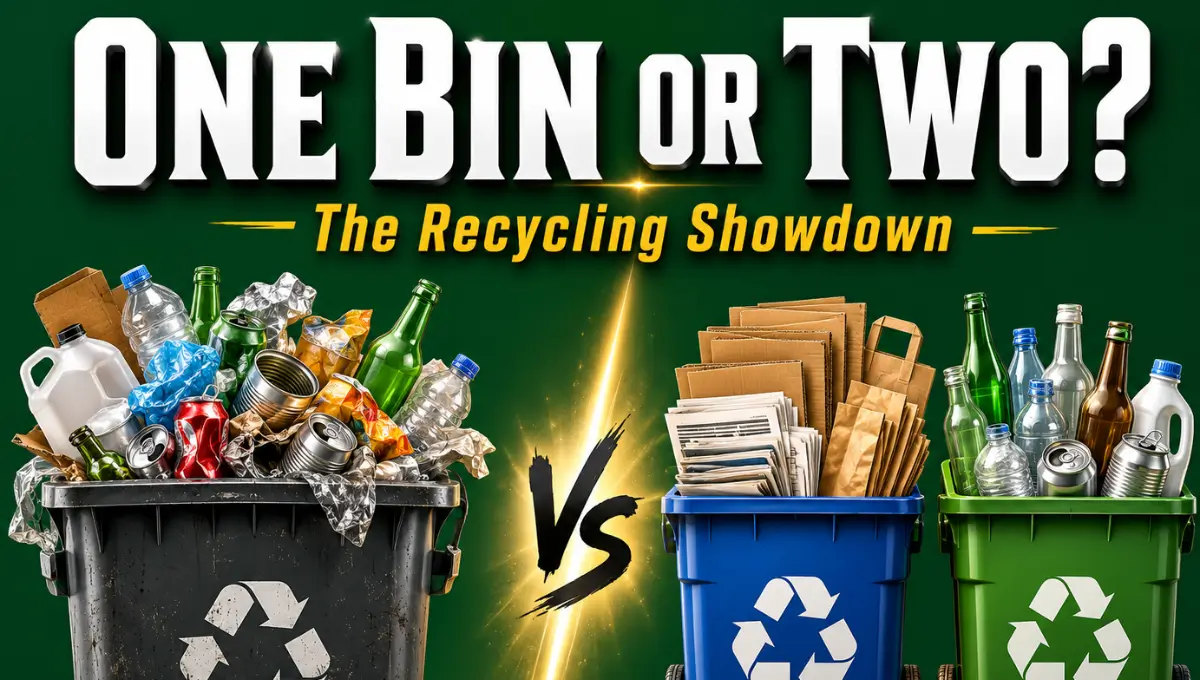
If your recycling bin asks you to toss everything in together — paper, cans, plastic, glass — you’re on a single-stream system.
If you have to separate paper from containers, your city runs a dual-stream (also called multi-stream) program.
That’s the short answer. The longer answer matters, because which system your city uses affects what you can recycle, how clean your recycling needs to be, and even whether your city’s recycling actually gets turned into new products or ends up in a landfill.
Most U.S. cities switched to single-stream recycling between the late 1990s and 2010s to make curbside recycling easier. But dual-stream hasn’t disappeared — some cities kept it, and a few have gone back to it, because it produces cleaner, more valuable recycled material.
Here’s what each system means, how they compare, and how to find out which one your address uses.
Quick Summary
- Single-stream: All recyclables go in one bin. Sorting happens later at a recycling facility.
- Dual-stream: You sort recyclables yourself — usually paper/cardboard in one bin, containers (glass, metal, plastic) in another.
- Single-stream is more convenient but has higher contamination rates, since broken glass and food residue mix with paper.
- Dual-stream produces cleaner material that sells for more, but costs more to collect since it often needs specialized trucks and more sorting labor upfront.
- Your city’s system is set locally — there’s no national rule, so check with your sanitation department or hauler to confirm which one applies to your address.
- Rules can change without much notice if a city switches haulers or updates its recycling contract, so it’s worth re-checking every year or two.
What Is Single-Stream Recycling?
Single-stream recycling — sometimes called “commingled” or “single-sort” recycling — means every recyclable material goes into one cart. Paper, cardboard, glass bottles, metal cans, and plastic containers all ride together to a Materials Recovery Facility (MRF), where machines and workers sort everything into separate commodities using magnets, optical scanners, screens, and manual picking.
This system took off starting in the 1990s for two reasons: it’s easier for residents, and it’s cheaper to collect. A single-compartment truck can be run by one driver instead of a full crew, and routes move faster because nobody’s sorting curbside.
The tradeoff is contamination. When glass breaks inside the truck, shards get embedded in paper and cardboard, which lowers their resale value.
The EPA notes that recycling providers who use single-stream collection accept mixed materials in one bin, while other providers still require separated, or “multi-stream,” collection — and either way, non-recyclable items placed in the wrong bin can contaminate an entire load.
What Is Dual-Stream (Multi-Stream) Recycling?
Dual-stream recycling asks residents to do some of the sorting themselves. Typically that means:
- Bin 1: Paper and cardboard (newspaper, mixed paper, corrugated boxes)
- Bin 2: Containers (glass, metal cans, plastic bottles and tubs)
Because the fiber stream never touches glass or wet containers, the paper stays cleaner and the glass stays more sortable by color. Collection trucks usually need two compartments — sometimes two separate trucks — which is more expensive to run than a single-stream route.
Connecticut’s Department of Energy and Environmental Protection describes single-stream as fully commingled collection, and notes that the alternative — dual-stream — keeps paper fiber separate from containers, resulting in less cross-contamination between the two material types, according to the state’s official single-stream recycling FAQ. Dual-stream was the standard in most U.S. cities before single-stream took over, and it’s still common in parts of the Northeast and in smaller towns that never converted.
Single-Stream vs. Dual-Stream: Side-by-Side Comparison
| Factor | Single-Stream | Dual-Stream |
|---|---|---|
| How you sort | Everything in one bin | Paper separate from containers |
| Resident effort | Low | Moderate |
| Collection trucks | Single-compartment, often one-person crew | Multi-compartment or two trucks |
| Collection cost | Generally lower | Generally higher |
| Contamination risk | Higher (broken glass, wet paper) | Lower |
| Material quality/resale value | Lower on average | Higher on average |
| Participation rates | Typically higher, since it’s more convenient | Can be lower due to extra effort |
| Where it’s common | Most large U.S. cities | Parts of the Northeast, some smaller towns |
Which System Does Your City Use?
There’s no federal standard — every city, county, or private hauler sets its own rules, and it can even vary block to block if two haulers serve the same county. To find out which system applies to your address:
- Search “[your city or county] recycling program” and look for the official sanitation department or public works page.
- Enter your address into your city’s waste/recycling lookup tool, if it has one — many cities offer this by ZIP code or street address.
- Check the sticker or insert card on your recycling bin. Single-stream bins are usually one large cart; dual-stream setups have two visibly separate bins or a divided cart.
- Call your local sanitation department or hauler directly if you’re not sure. This also confirms current rules, since programs do change.
Why Contamination Is the Real Difference That Matters
Contamination is the single biggest issue driving the single-stream vs. dual-stream debate. When non-recyclable or wrongly-sorted items get mixed in, an entire load can be rejected and sent to a landfill instead of a recycling facility.
Industry estimates on single-stream contamination vary by region and hauler, but multiple sources — including waste haulers and recycling equipment manufacturers — put average contamination in single-stream loads well above what dual-stream systems typically see, largely because broken glass and paper end up mixed together in a single-stream cart. Dual-stream programs avoid most of that cross-contamination simply because paper and containers never share a bin.
That’s also why some cities that switched to single-stream in the 2000s and 2010s have faced higher rejection rates and lower resale prices for their recycled material, especially after international scrap-paper markets tightened their quality standards in recent years.
Pros and Cons at a Glance
Single-stream pros: easier for residents, higher participation, faster collection routes, lower collection labor costs.
Single-stream cons: more contamination, lower material value, more equipment needed at the sorting facility.
Dual-stream pros: cleaner paper and glass, higher resale value, fewer rejected loads.
Dual-stream cons: more effort for residents, higher collection costs, sometimes lower participation.
Which One Is Better for the Environment?
Neither system is universally “better” — it depends on how well it’s run locally. Single-stream can divert more material from landfills simply because more people participate, but it’s more likely to result in that same material eventually landing in a landfill due to contamination. Dual-stream keeps more of what’s collected actually recyclable, but only works well if residents commit to sorting it correctly and if participation stays high enough.
The most useful thing you can do either way: only put in what your local program actually accepts, and never put items in “hoping” they’ll figure it out at the facility. That single habit does more for recycling quality than the choice between systems.
Frequently Asked Questions
Is single-stream or dual-stream recycling more common in 2026?
Single-stream is more common across the U.S. today. Most large cities converted decades ago for convenience and lower collection costs, though pockets of dual-stream remain, especially in the Northeast.
Does dual-stream recycling actually get recycled more than single-stream?
Not necessarily more — but the material collected under dual-stream tends to have lower contamination and a better chance of actually being reprocessed into new products, rather than rejected and landfilled.
Can I tell which system my city uses just by looking at my bin?
Usually, yes. One large cart for everything means single-stream. Two separate bins, or a cart divided down the middle, means dual-stream.
Why did my city switch from dual-stream to single-stream (or vice versa)?
Cities typically switch to single-stream to cut collection costs and boost participation. Some switch back to dual-stream, or add stricter sorting rules, after contamination gets too high and recycling loads start getting rejected by buyers.
What happens if I put the wrong item in my recycling bin?
It can contaminate the whole load. Depending on your hauler’s rules, that can mean a small percentage of contamination is tolerated, or it can mean the entire bin gets sent to the landfill instead of a recycling facility.
Where can I find my city’s exact recycling rules?
Your city or county sanitation department’s website is the most reliable source, since rules vary by hauler and change periodically. Many offer an address- or ZIP-code-based lookup tool for exact pickup and sorting rules.
Sources
Last verified: July 2026. Recycling rules vary by city, county, and hauler, and can change without notice — confirm current rules with your local sanitation department before sorting.
Related read: Looking for your actual pickup days and holiday schedule? See our guide to finding your local recycling and trash pickup schedule by address or ZIP code.
Bottom line: Whether you sort or not depends entirely on your local program — not a national standard. Check your city or county sanitation department’s website (or call them directly) to confirm which system you’re on and what’s accepted in your bin.