
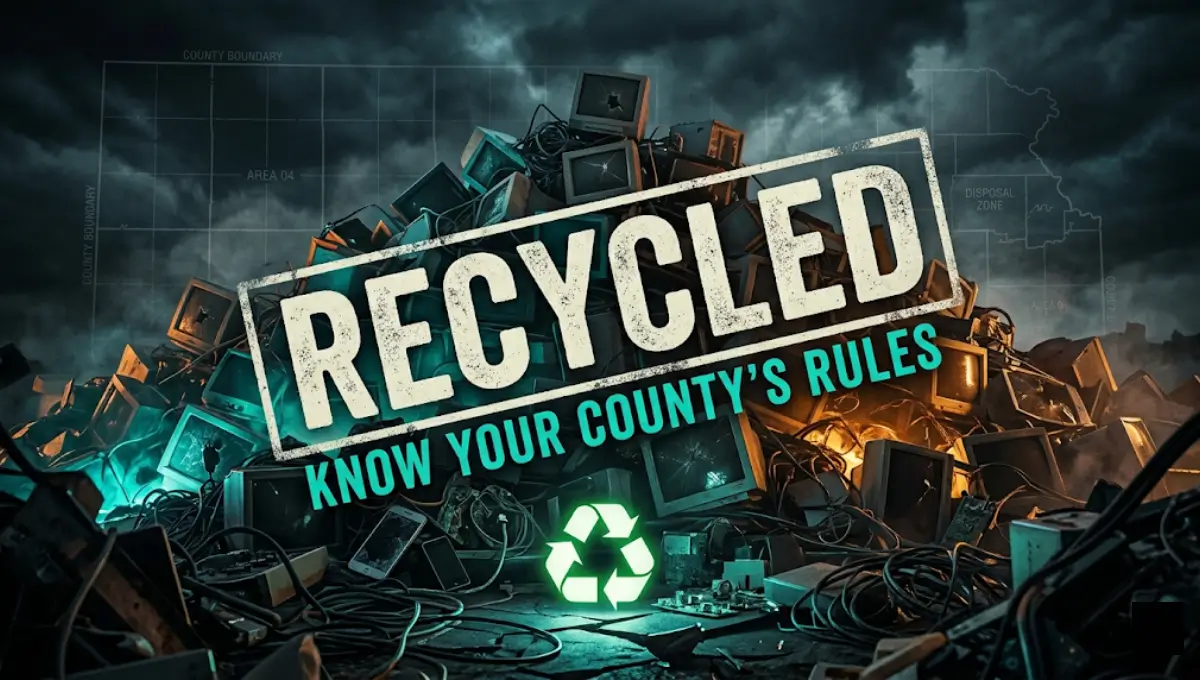
E-waste recycling by county is the primary way most Americans dispose of old electronics safely and legally.
Since the U.S. has no federal e-waste recycling law, county-level programs — including drop-off events, permanent collection centers, and retailer partnerships — are the backbone of electronics waste management across the country.
Whether you have an old TV, a broken laptop, or a pile of cables, your county may offer free or low-cost recycling options right in your backyard.
Quick Answer Summary:
- The U.S. has no federal e-waste law — your county program is your primary recycling option in 25 states
- Most county events accept laptops, phones, TVs, monitors, printers, and cables for free
- Refrigerators, air conditioners, solar panels, and vehicle batteries are refused at nearly all county events
- Only 25 states + D.C. have e-waste legislation; the rest depend entirely on county events and retailer drop-offs
- Vermont, California, Oregon, Washington, and Connecticut lead the country with manufacturer-funded, free collection programs
- In 2026, new laws in California, Oregon, Illinois, and Vermont expanded what counties must collect, including e-bike batteries and smart speakers
- Always erase your data before drop-off and verify your recycler holds R2 or e-Stewards certification
What Is E-Waste Recycling by County?
County-level e-waste recycling refers to programs, collection sites, drop-off events, and permanent facilities managed or sponsored by county governments to collect end-of-life electronics from residents.
These programs exist for critical environmental and legal reasons:
- Electronics contain hazardous materials — lead, mercury, cadmium, and flame retardants — that are illegal to landfill in 23 states
- A single CRT television or monitor can contain 2–8 pounds of lead, classified as hazardous waste by the EPA
- E-waste accounts for less than 2% of landfill volume but an estimated two-thirds of all heavy metals found in landfills
(Source: Dropcurb E-Waste Report Card — https://dropcurb.com/blog/e-waste-disposal-report-card)
County programs generally take four forms:
- Permanent drop-off sites — year-round, staffed collection centers
- Periodic collection events — quarterly, semi-annual, or annual drives
- Household Hazardous Waste (HHW) + E-Waste co-events — combined collection days
- Retailer partnerships — programs run through Best Buy, Staples, and office supply stores
Key Facts & Explanation
The U.S. Has No Federal E-Waste Law
As of 2026, only 25 states plus Washington D.C. have enacted e-waste legislation. The remaining 25 states rely entirely on county programs, retailer drop-offs, and private recyclers.
(Source: SAMR Inc. — https://samrinc.com/blog/e-waste-laws-2026/)
Global E-Waste Is a Growing Crisis
The UN’s Global E-Waste Monitor 2024 reports that a record 62 million tonnes of e-waste was generated in 2022, with only 22.3% formally collected and recycled. The U.S. formally collected 4,054 kilotonnes of e-waste in 2022. Global generation is projected to reach 82 million tonnes by 2030, while the recycling rate is expected to drop to 20% as generation outpaces capacity.
(Source: Global E-Waste Monitor 2024, ITU/UNITAR — https://ewastemonitor.info/the-global-e-waste-monitor-2024/)
Recycling Has Real Material Value
Recycling 1 million cell phones can yield 75 lbs of gold, 772 lbs of silver, and 35,274 lbs of copper — making e-waste recycling economically important, not just environmentally necessary.
(Source: Global E-Waste Monitor data via Dropcurb — https://dropcurb.com/blog/e-waste-disposal-report-card)
How County Programs Are Funded
The funding model for county e-waste programs depends almost entirely on whether your state has passed an e-waste law:
| Funding Model | How It Works | Example States |
|---|---|---|
| Manufacturer EPR (Extended Producer Responsibility) | Electronics makers pay for free collection networks | California, Oregon, Washington, Vermont, Connecticut |
| Consumer Fee at Purchase | Fee added to electronics sale price ($4–$10) | California (SB 20) |
| County/Municipal Budget | Local government funds collection events | States without e-waste laws |
| Voluntary Retailer Programs | Best Buy, Staples funded by brand initiative | All 50 states (national chain programs) |
| Grant Programs | Federal/state grants support collection infrastructure | Illinois CERA program, EPA SWIFR grants |
In January 2026, the EPA awarded $58 million in SWIFR (Solid Waste Infrastructure for Recycling) grants for recycling infrastructure, part of a $275 million program funded by the Bipartisan Infrastructure Law. Delaware County, Pennsylvania, received $5 million for expanded recycling capacity.
(Source: Resource Recycling — https://resource-recycling.com/recycling/2026/01/05/epa-awards-58m-for-waste-recycling-infrastructure/)
What Is Accepted vs. Not Accepted at County E-Waste Events
Commonly Accepted Electronics
Most county programs accept the following:
- Computers & Computing Devices: Desktops, laptops, tablets, Chromebooks, servers
- Displays: CRT monitors, LCD/LED monitors, flat-screen and CRT televisions
- Communication Devices: Cell phones, smartphones, landline phones, pagers
- Peripherals: Keyboards, mice, printers, scanners, fax machines, cables, modems, routers
- Audio/Video Equipment: DVD/VCR players, stereos, game consoles, cameras, music players
- Small Appliances (select locations only): Microwaves, electric tools, holiday lights
(Sources: Maryland Department of the Environment — https://mde.maryland.gov; SWALCO Lake County IL — http://www.swalco.org/162/Accepted-Non-acceptable-Items; Loudoun County VA — https://www.loudoun.gov/408/Electronics-Recycling)
Items NOT Accepted at Most County Events
| Category | Specific Items | Reason |
|---|---|---|
| Large Appliances (White Goods) | Refrigerators, washers, dryers, stoves, freezers | Require specialized hazmat removal |
| Climate Control Equipment | Air conditioners, dehumidifiers | Freon handling required |
| Hazardous/Chemical Waste | Paint, solvents, motor oil, pesticides | Separate HHW programs apply |
| Lighting | Fluorescent bulbs, ballasts | Mercury — separate program |
| Safety Devices | Smoke detectors, fire extinguishers | Radioactive/chemical components |
| Medical Waste | Sharps, prescription drugs | Regulated medical waste stream |
| Non-Electronic Items | VHS tapes, CDs, DVDs (disc only) | No electronic components |
| Solar Panels | All types | Contact manufacturer for take-back |
| Vehicle Batteries | Car, truck, marine batteries | Separate auto recycling stream |
| Commercial/Business Waste | Bulk business electronics | Most county programs are residential-only |
Real-World Example: Loudoun County, VA explicitly refuses refrigerators, freezers, dehumidifiers, air conditioners, stoves, washers, dryers, fluorescent light bulbs, smoke alarms, mercury thermostats, household batteries, vehicle batteries, and solar panels.
(Source: Loudoun County VA — https://www.loudoun.gov/408/Electronics-Recycling)
State-by-State E-Waste Law Grades (2026)
Based on data from the EPA, state environmental agencies, and the Electronics Recycling Coordination Clearinghouse:
| Grade | States |
|---|---|
| A | California, Connecticut, Oregon, Vermont, Washington |
| B | Illinois, Indiana, Maine, Michigan, Minnesota, New Jersey, New York, Wisconsin |
| C | Hawaii, Maryland, Missouri, North Carolina, Oklahoma, Pennsylvania, Rhode Island, Virginia, D.C. |
| D | Colorado, South Carolina, Texas, West Virginia |
| F | Alabama, Alaska, Arizona, Arkansas, Delaware, Florida, Georgia, Idaho, Iowa, Kansas, Kentucky, Louisiana, Massachusetts, Mississippi, Montana, Nebraska, Nevada, New Hampshire, New Mexico, North Dakota, Ohio, South Dakota, Tennessee, Utah, Wyoming |
(Source: Dropcurb E-Waste Report Card — https://dropcurb.com/blog/e-waste-disposal-report-card)
What Top States Got Right
- Vermont: Highest per-capita collection rate — 7.7 pounds per person, nearly 6× the national average; strict landfill ban enforced
- California: Electronic Waste Recycling Act (SB 20, 2003); 2+ billion pounds recycled since 2005; operated through CalRecycle and DTSC
- Washington: Manufacturer-funded E-Cycle program; 460+ million pounds collected since 2009
- Oregon: E-Cycles program expanded in 2026 to cover routers, modems, game consoles, scanners, and small servers
- Connecticut: Manufacturer EPR enacted 2007; registration fees fund statewide certified collection network
(Source: SAMR Inc. — https://samrinc.com/blog/e-waste-laws-2026/)
2026 New Laws Affecting County E-Waste Programs
California – SB 1215 (Effective January 1, 2026)
Battery-embedded products added to California’s Covered Electronic Waste Recycling Program. New covered items include cordless tools, smart speakers, personal grooming devices, and toys. Consumers pay a disposal fee at point-of-sale. Penalties for violations can reach $70,000 per violation per day.
(Source: EINPresswire — https://www.einpresswire.com/article/868567596/electronics-recycling-los-angeles-new-2026-battery-embedded-products-law)
Oregon – E-Cycles Program Expansion (January 1, 2026)
Oregon’s EPR program expanded to cover scanners, DVD players, VCRs, music players, game consoles, digital converter boxes, cable receivers, routers, modems, and small servers.
Illinois – Battery EPR (Effective 2026)
Sellers and distributors must have battery recycling programs in place. New battery collection points required statewide by end of 2028; labeling requirements take effect in 2029.
Vermont – Battery EPR Expansion (2026)
Vermont extended its 2014 battery EPR law to include rechargeable batteries, devices with easily removable batteries, and medium-format batteries (4.4–25 lbs), including e-bike batteries.
Colorado & Washington – Right-to-Repair Laws (2026)
Both states enacted laws requiring manufacturers to provide access to parts, tools, and repair information for electronics. Colorado’s law bans parts pairing and blocks manufacturers from preventing independent repair providers from installing functional replacement parts.
(Source: WasteDive — https://www.wastedive.com/news/new-laws-2026-battery-epr-waste-recycling-organics-landfill-policy/808714/)
Best Practices for Using County E-Waste Programs
- Erase personal data before drop-off — Delete files, perform factory resets on phones and tablets, or request on-site hard drive destruction (available for a fee at some events)
- Check the accepted items list before attending — Each county event has its own accepted/rejected list; call ahead or check the official county website
- Separate residential from commercial waste — Nearly all county programs accept residential items only; businesses must use certified commercial e-waste vendors
- Remove packaging — All items should be free of operating manuals, boxes, and packaging materials
- Note item limits — Some programs cap the number of items per visit (e.g., Ventura County limits 5 CRT/TV monitors per visit)
- Check for registration requirements — Some events, such as Mercer County PA (September 2026 events), require advance online registration
- Use certified recyclers — Whether through county programs or private vendors, verify R2 or e-Stewards certification to ensure electronics aren’t illegally exported
(Sources: SWALCO — http://www.swalco.org; Loudoun County VA — https://www.loudoun.gov/408/Electronics-Recycling; Mercer County PA — https://www.mercercountypa.gov/recycling/Guides/2026.Electronics.Recycling.Guide.pdf)
Recycler Certifications to Look For
| Certification | Governed By | Key Focus |
|---|---|---|
| R2 (Responsible Recycling) v3 | SERI (Sustainable Electronics Recycling International) | Environmental, worker health/safety, data destruction, downstream accountability |
| e-Stewards® | Basel Action Network (BAN) | Prohibits export of hazardous e-waste to developing nations; no prison labor; data security |
Both are accredited by the ANSI-ASQ National Accreditation Board (ANAB). Washington D.C.’s eCYCLE program now requires e-Stewards certification specifically.
(Source: US EPA Certified Electronics Recyclers — https://www.epa.gov/electronics-batteries-management/certified-electronics-recyclers)
Common Mistakes & Misconceptions
| Misconception | Verified Fact |
|---|---|
| “E-waste recycling is too complicated” | County programs provide drop-off sites with no technical steps required |
| “It’s too expensive to recycle electronics” | Most county and state EPR programs offer free recycling; fees mainly apply to CRTs or TVs at certain events |
| “All recycled e-waste is handled safely” | An estimated 40–60% of U.S. collected e-waste is exported to developing countries where informal processing occurs |
| “Throwing electronics in the trash is legal everywhere” | 23 states ban electronics from landfills; fines range from $25 (IL) to $10,000+/day (OR, WA) |
| “County programs accept all electronics” | Most exclude white goods, solar panels, batteries (varies by state), and commercial waste |
| “Small personal electronics can go in curbside recycling” | Standard curbside bins do not accept electronics — they must go to designated e-waste sites |
(Source: Dropcurb — https://dropcurb.com/blog/e-waste-disposal-report-card)
Frequently Asked Questions
Q1: Is e-waste recycling free at county events?
In most cases, yes — particularly in states with EPR (Extended Producer Responsibility) laws like California, Oregon, Washington, Vermont, and Connecticut. In states without e-waste laws, some events may charge a small fee for items like CRT televisions or desktop monitors. Always check your county’s official website before attending.
Q2: Can businesses drop off electronics at county e-waste events?
No. Nearly all county programs are residential-only. Businesses, institutions, and governments are explicitly excluded from programs such as SWALCO (Lake County, IL) and LA County’s S.A.F.E. Centers. Businesses must use certified commercial e-waste vendors.
Q3: What happens to my data when I recycle electronics?
Always erase your data before drop-off. Perform a factory reset on smartphones and tablets, delete files from computers, and optionally request on-site hard drive destruction (available for a fee at some events). Certified recyclers under R2 and e-Stewards standards also include data security requirements in their certification.
Q4: How do I find a county e-waste recycling event near me?
Use the following official resources:
US EPA Certified Recyclers: https://www.epa.gov/electronics-batteries-management/certified-electronics-recyclers
CalRecycle (California): https://www.calrecycle.ca.gov/Electronics/
E-Cycle Washington: https://ecology.wa.gov/waste-toxics/reducing-recycling-waste/e-cycles
Oregon E-Cycles: https://www.ecyclesoregon.org/
Maryland eCycling: https://mde.maryland.gov/programs/Land/RecyclingandOperationsprogram/Pages/ecycling.aspx
Illinois EPA (CERA): https://epa.illinois.gov/topics/waste-management/electronics-recycling.html
Q5: Are solar panels accepted at county e-waste events?
No. Solar panels are consistently refused at county e-waste events. The recommended approach is to contact the manufacturer directly for a take-back program.
Conclusion
E-waste recycling by county is the most accessible path for most Americans to safely and legally dispose of old electronics. Whether your state has a robust EPR law like California or Vermont, or relies entirely on county-organized events, there are options available to you — often for free. The key is knowing what’s accepted, where to go, and how to protect your personal data before you hand over your devices.
Key Takeaway: Check your county’s official government website or the EPA’s certified recycler search tool before your next drop-off to confirm accepted items, event dates, and any registration requirements. When in doubt, call ahead — rules vary significantly from county to county.
Confirmed Source URLs
| Source | URL |
|---|---|
| US EPA – Certified Electronics Recyclers | https://www.epa.gov/electronics-batteries-management/certified-electronics-recyclers |
| Global E-Waste Monitor 2024 (ITU/UNITAR) | https://ewastemonitor.info/the-global-e-waste-monitor-2024/ |
| Dropcurb – E-Waste Disposal Report Card (All 50 States) | https://dropcurb.com/blog/e-waste-disposal-report-card |
| SAMR Inc. – E-Waste Laws 2026 FAQ | https://samrinc.com/blog/e-waste-laws-2026/ |
| WasteDive – New 2026 Recycling Laws | https://www.wastedive.com/news/new-laws-2026-battery-epr-waste-recycling-organics-landfill-policy/808714/ |
| Resource Recycling – EPA $58M SWIFR Grants | https://resource-recycling.com/recycling/2026/01/05/epa-awards-58m-for-waste-recycling-infrastructure/ |
| EINPresswire – LA E-Waste SB 1215 (2026) | https://www.einpresswire.com/article/868567596/electronics-recycling-los-angeles-new-2026-battery-embedded-products-law |
| Maryland Department of the Environment – eCycling | https://mde.maryland.gov/programs/Land/RecyclingandOperationsprogram/Pages/ecycling.aspx |
| Loudoun County, VA – Electronics Recycling | https://www.loudoun.gov/408/Electronics-Recycling |
| SWALCO – Lake County IL – Accepted Items | http://www.swalco.org/162/Accepted-Non-acceptable-Items |
| Zero Waste Sonoma – E-Waste Disposal | https://zerowastesonoma.gov/e-waste-disposal |
| Ventura County Public Works – E-Waste | https://publicworks.venturacounty.gov/wsd/iwmd/ewaste/ |
| Mercer County PA – 2026 Recycling Guide | https://www.mercercountypa.gov/recycling/Guides/2026.Electronics.Recycling.Guide.pdf |
| Illinois EPA – CERA Program | https://epa.illinois.gov/topics/waste-management/electronics-recycling.html |
| CalRecycle – California Electronics Recycling | https://www.calrecycle.ca.gov/Electronics/ |
| E-Cycle Washington | https://ecology.wa.gov/waste-toxics/reducing-recycling-waste/e-cycles |
| Oregon E-Cycles | https://www.ecyclesoregon.org/ |
| Global E-Waste Statistics Partnership – USA 2022 | https://globalewaste.org/statistics/country/united-states-of-america/2022/ |
| Electronic Asset Security – U.S. E-Waste Laws 2025 | https://electronicassetsecurity.com/understanding-u-s-e-waste-laws-in-2025/ |
| Electronics Recycling Coordination Clearinghouse | https://www.ecycleclearinghouse.org/ |
Last updated: April 2026. All facts verified from official government sources, state environmental agencies, and peer-reviewed global data. Information marked [NOT VERIFIED — gap in available data] where confirmed data was unavailable.