
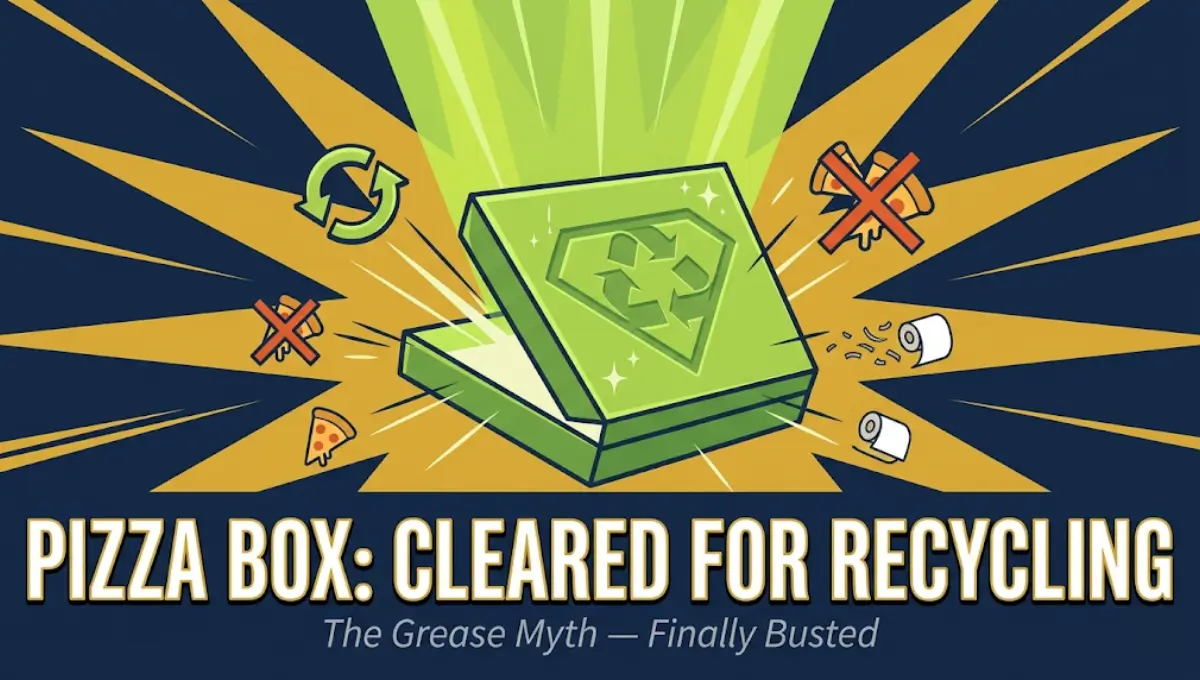
Yes, pizza boxes are recyclable — and the old rule that grease makes them unrecyclable has been scientifically debunked.
As long as leftover food is removed, most pizza boxes can go straight into your curbside recycling bin.
Today, 82% of Americans have access to a recycling program that accepts pizza boxes.
Quick Summary:
- ✅ Pizza boxes are recyclable corrugated cardboard
- ✅ Light grease and minor cheese residue are NOT barriers to recycling
- ⚠️ Food scraps (crusts, toppings) must be removed before recycling
- ❌ Heavily oil-soaked boxes should be composted, not recycled
- 🔬 A landmark 2020 study confirmed that typical grease levels are well within acceptable recycling thresholds
- 📍 Always check your local municipality’s rules — acceptance varies by area
Clear Answer to the Question
The U.S. Environmental Protection Agency (EPA) puts it plainly: “Pizza boxes are recyclable; pizza is not!“
Pizza boxes are made from corrugated cardboard — one of the most recycled materials in the world, with a recycling rate of 91.4% in 2021.
The myth that any amount of grease automatically disqualifies a box has been thoroughly disproven. What matters is removing leftover food before tossing the box in your bin.
Key Facts & Explanation
The science here is clear and well-established.
A landmark 2020 study by WestRock and the Recycling Partnership found that a typical pizza box contains only 1–2% grease by weight — roughly one-tenth of the acceptable contamination threshold for corrugated cardboard recycling.
The study tested mixed recycling loads containing 8% greasy pizza boxes and found that the recycled materials produced were still viable for packaging, meeting tensile strength requirements. Cheese tends to solidify and gets screened out during the pulping process, posing no significant recycling problem.
This research was later endorsed by the American Forest & Paper Association (AF&PA) and confirmed by the EPA.
Historically, grease was considered a problem because oil repels water, and paper recycling relies on a water-based pulping process. But modern mills have made that concern largely obsolete.
Advanced repulping equipment can handle small amounts of food residue without compromising recycled paper quality. Food solids — not grease — are the real contaminant.
According to the EPA, contamination rates above 10–15% can cause recycling facilities to reject whole shipments — but typical pizza boxes fall far below this threshold.
Types & Categories: What Kind of Box Do You Have?
Not all pizza boxes are in the same condition. Here’s how to think about yours:
Recyclable in most programs:
- Empty, clean boxes
- Boxes with light grease stains
- Boxes with minor solidified cheese residue
- Frozen pizza boxes (no grease at all)
- The clean lid of a box whose bottom is heavily soiled
Recyclable after prep:
- Boxes with food debris (crusts, toppings) — remove the food first
Better off composted:
- Heavily oil-saturated bottoms
- Boxes with wax paper or plastic liners (remove those first; recycle the cardboard)
Not recyclable:
- Boxes with plastic film or glossy coatings
- Boxes with active PFAS coatings (more on this below)
(Source: AF&PA, EPA, Earth911 — earth911.com)
What Is Allowed vs. Not Allowed
| Condition | Recyclable? | What To Do |
|---|---|---|
| Empty, clean box | ✅ Yes | Flatten and recycle |
| Light grease stains | ✅ Yes | Remove food, recycle |
| Minor solidified cheese | ✅ Yes | Scrape off cheese, recycle |
| Food debris present | ⚠️ Conditionally | Remove food, then recycle |
| Heavily oil-soaked bottom | ❌ No | Compost or trash |
| Clean top, soiled bottom | ✅ Partially | Tear apart; recycle the clean half |
| Frozen pizza box | ✅ Yes | Remove plastic, recycle box |
| Plastic film or glossy coating | ❌ No | Trash or check local rules |
Best Practices: Step-by-Step Pizza Box Disposal
Follow these simple steps and you’ll never have to guess again:
- Remove all leftover pizza — crusts, toppings, and cheese must come out first.
- Scrape off any stuck-on cheese or sauce — a quick wipe makes a difference.
- Remove any wax paper or plastic liners — recycle the cardboard only.
- Assess the grease level — light to moderate is fine; soaking wet is not.
- Tear the box if needed — if the top lid is clean but the bottom is heavily soiled, tear them apart. Recycle the clean half and compost or trash the greasy half.
- Flatten the box — compact it to save space in your bin.
- Check your local guidelines — acceptance criteria vary by municipality. Use Domino’s “Recycle My Pizza Box” tool (powered by WestRock) and enter your ZIP code for local guidance.
Composting as a Smart Alternative
When recycling isn’t available or the box is heavily soiled, composting is the recommended eco-friendly alternative. Commercial composting programs readily accept greasy pizza boxes, and cardboard in compost provides essential carbon (brown material) to balance nitrogen-rich food waste.
For backyard composting, shred boxes into small pieces to speed decomposition, and avoid heavily oily sections to prevent attracting rodents or disrupting compost balance.
Common Mistakes & Misconceptions
Myth vs. Fact
Myth: Any grease makes a pizza box unrecyclable. Fact: False — typical grease levels of 1–2% are well within acceptable recycling thresholds, as confirmed by the 2020 WestRock/Recycling Partnership study.
Myth: Cheese contamination ruins recycling batches. Fact: False — cheese solidifies and gets screened out during the pulping process.
Myth: You must throw the whole box away if any part is greasy. Fact: False — tear off the clean section (usually the lid) and recycle it separately.
Myth: Tossing dirty boxes in recycling is better than the trash. Fact: False — this is called “wish-cycling.” Heavily contaminated batches may be rejected and sent to landfill anyway, potentially ruining otherwise recyclable material in the same load.
An Emerging Factor: PFAS Coatings
Some pizza boxes — particularly older designs — may contain PFAS (per- and polyfluoroalkyl substances), “forever chemicals” used to add grease resistance to food packaging. PFAS-treated boxes can complicate both recycling (chemical interference with pulping) and composting (PFAS persistence in soil).
The good news: the European Union’s Packaging and Packaging Waste Regulation (PPWR) took effect in 2026, banning PFAS from food-contact packaging including pizza boxes above defined thresholds. Most modern U.S. pizza box manufacturers have also been moving away from PFAS coatings in response to regulatory and consumer pressure.
Quick check: If grease beads up on your box rather than soaking in, it may have a PFAS coating — verify with your local recycler.
Recent Updates (2024–2026)
New York City (May 2024): Central Park officials introduced specially designed pizza box recycling bins, which have since been installed at locations throughout NYC, addressing the problem of bulky pizza boxes overwhelming standard public bins.
New York City (April 2025): NYC mandated that all residents separate food scraps and food-soiled paper from trash, with pizza boxes explicitly accepted in the brown bin (organics/composting) program.
California (Ongoing): Under California’s SB 1383, all jurisdictions must provide organics collection statewide. Food-soiled pizza boxes qualify for compostables carts across California municipalities.
AF&PA (October 2025): The American Forest & Paper Association reconfirmed that “the spots with grease and little bits of cheese can stay. Paper mills are equipped to handle it,” and urged all communities to update local guidelines to explicitly accept pizza boxes.
Earth911 (February 2026): Earth911 published an updated guide confirming 82% U.S. program acceptance and providing city-specific composting guidance.
FAQs
Q: Can I recycle a pizza box with grease stains?
Yes. Light to moderate grease stains are acceptable at nearly all U.S. recycling facilities. The 2020 WestRock/Recycling Partnership study confirmed that typical pizza grease levels (1–2%) are far below the contamination threshold. (Source: AF&PA — afandpa.org)
Q: What if only part of my box is greasy?
Tear the box apart. Recycle the clean section (usually the lid) and compost or trash the heavily soiled bottom portion. (Source: Earth911 — earth911.com)
Q: Can I compost a pizza box instead of recycling it?
Absolutely — and for heavily soiled boxes, it’s the preferred option. Commercial and municipal composting programs widely accept greasy pizza boxes. For home composting, shred the box first. (Source: Zero Waste Sonoma — zerowastesonoma.gov)
Q: How do I know if my local program accepts pizza boxes?
Check your municipality’s website, or use Domino’s “Recycle My Pizza Box” ZIP code lookup tool (powered by WestRock). As of 2026, 82% of Americans have access to a program that accepts pizza boxes.
Q: Do I need to remove the cheese before recycling?
You should remove any large chunks of food, but small residue is fine. Cheese solidifies and gets screened out naturally during the paper mill pulping process.
Conclusion
The bottom line is simple: pizza boxes belong in your recycling bin, not the trash. The decades-old myth that grease makes them unrecyclable has been put to rest by rigorous scientific research. Just remove the leftover pizza, flatten the box, and recycle. If your box is heavily soaked, compost it. And if you’re unsure about your local rules, look them up — because the science is no longer the barrier.
Roughly 3 billion pizza boxes are used in the U.S. annually, representing about 600,000 tons of corrugated cardboard. Getting this right — at scale — genuinely matters.
Confirmed Source URLs
| Source | URL |
|---|---|
| U.S. EPA — Pizza Box Recycling Guidance | https://www.epa.gov |
| AF&PA — Pizza Box Recyclability (Oct 2025) | https://www.afandpa.org/news/2025/pizza-box-recyclable |
| The Recycling Partnership — Pizza Box Study & Toolkit | https://recyclingpartnership.org/pizzaboxes/ |
| Earth911 — Updated Guide (Feb 2026) | https://earth911.com/home-garden/yes-pizza-boxes-are-recyclable/ |
| Rumpke Waste Services — Updated Jan 2026 | https://www.rumpke.com/blog/are-pizza-boxes-recyclable |
| Zero Waste Sonoma — Composting Guidance | https://zerowastesonoma.gov/materials/pizza-box |
| Rockland Green — Recycling Myths vs. Facts (2025) | https://www.rocklandgreen.com/news-and-events/todays-recycling-myths-vs-facts/ |
| EU PPWR / Renew Europe — PFAS Packaging Ban (2026) | https://www.reneweuropegroup.eu |
| Red Oak Sanitation — Complete Recycling Guide | https://sanitation-services.com/blog/can-you-recycle-pizza-boxes-complete-guide-to-pizza-box-recycling/ |
| Fibre Box Association — Corrugated Cardboard Guidance | https://www.fibrebox.org/pizza-boxes/ |