
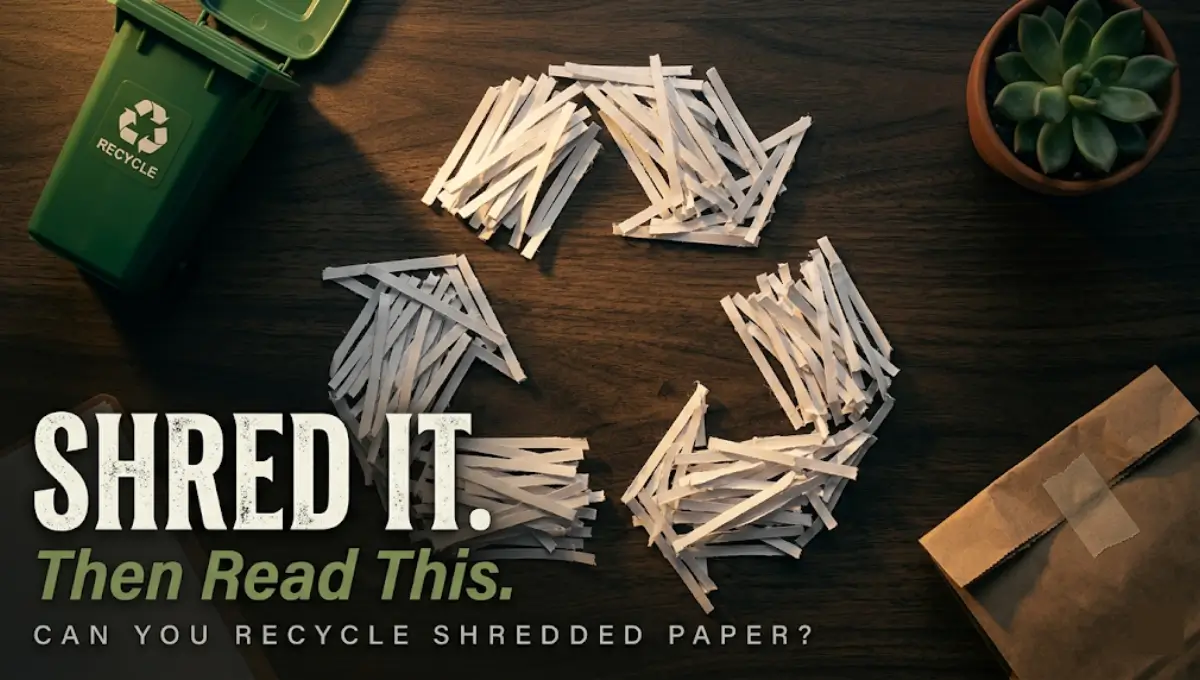
Yes, shredded paper is technically recyclable — but most curbside programs won’t take it loose.
Whether your shredded paper gets recycled depends entirely on your local municipality’s rules and how you prepare it for disposal.
Read on to learn exactly what to do, what to avoid, and smarter alternatives you may not have considered.
Quick Summary:
- Shredded paper is made of recyclable fiber, but its small size causes problems at sorting facilities
- Most curbside bins do not accept loose shredded paper
- Bagging it in a paper bag or cardboard box may make it acceptable — check your local rules first
- Composting is a reliable, eco-friendly alternative for plain, non-glossy shredded paper
- Only shred documents with truly sensitive information; recycle everything else whole
- Drop-off centers and community shred events are good options when curbside won’t do
Clear Answer: Is Shredded Paper Recyclable?
Shredded paper is recyclable — but whether your local recycling program accepts it is another matter.
The U.S. EPA and the American Forest & Paper Association (AF&PA) both confirm that acceptance depends entirely on your local guidelines.
Even though shredded paper is made of the same recyclable fiber as regular paper, the physical characteristics created by shredding introduce complications that cause many programs to reject it from standard curbside bins.
Key Facts & Explanation: Why Shredded Paper Is Harder to Recycle
Shorter Fibers, Lower Value
When paper is shredded, its long cellulose fibers are cut into very short fragments, downgrading the material from high-grade to mixed-grade.
This means shredded paper can only be recycled into lower-value products such as paper towels and packing paper — not high-quality office paper.
Sorting Problems at Recycling Facilities
Material Recovery Facilities (MRFs) rely on automated sorting equipment — optical scanners, disc screens, and conveyor belts — designed for standard-sized items. Shredded paper causes real operational headaches. Specifically, it:
- Falls through sorting screens and jams optical scanners that need a minimum piece size to correctly identify materials
- Floats through the air like confetti when trucks tip loads, contaminating glass, plastic, and metal recyclable streams
- Clogs equipment gears, increasing facility maintenance costs and downtime
In the United States, approximately 25% of items placed in recycling bins are not actually recyclable, with shredded paper cited as one of the less obvious culprits.
Types & Categories: Not All Shredding Is Equal
The type of shredder you use matters more than most people realize.
Micro-cut shredding produces smaller pieces that are even less likely to be successfully recycled than strip-cut or cross-cut shredding. If you’re shredding documents that you hope to recycle, strip-cut or cross-cut shredders produce larger fragments that recycling programs are more likely to accept.
Paper types also matter for composting:
- Plain white or lightly printed office paper — compost-safe ✅
- Non-glossy newspaper — compost-safe ✅
- Glossy or coated paper — avoid composting ❌
- Heavily dyed or color-printed paper — avoid composting ❌
What Is Allowed vs. Not Allowed
✅ Generally Allowed (with conditions)
| Method | Key Conditions |
|---|---|
| Curbside bin (select communities) | Must be in a sealed paper bag or cardboard box, labeled “Shredded Paper” |
| Drop-off recycling centers | Bag in a clear, labeled paper bag or box |
| Community shred events | Pre-shredded paper accepted; sent to specialized processing |
| Composting | Plain, non-glossy, non-coated paper only |
| Reuse as packing material | Store in a dry container |
| Animal bedding | Clean, uncoated, non-glossy paper only |
❌ Generally Not Allowed
| What to Avoid | Why |
|---|---|
| Loose shredded paper in curbside bin | Contaminates other recyclables; jams equipment |
| Glossy or coated paper in compost | May contain harmful chemicals or synthetic coatings |
| Heavily dyed paper in compost | Heavy-dye inks may be harmful |
| Wet or food-contaminated shredded paper | Renders recyclables unprocessable |
| Shredded paper mixed with staples, paperclips, or plastic | Contaminates and damages MRF equipment |
Sources: U.S. EPA | AF&PA | Earth911
Best Practices & Recommendations
Both the AF&PA and EPA emphasize a “Think Before You Shred” philosophy: only shred documents that contain truly sensitive personal information — bank statements, pay stubs, tax forms, medical records, credit card applications, and anything with your Social Security or credit card number.
Documents that don’t contain sensitive information — folders, greeting cards, books, magazines, newspapers, and general mail — should be recycled whole, where they are far more likely to be successfully processed.
Here are the top recommended actions:
- Check your local program first. Rules vary significantly by city, county, and state. Never assume curbside is OK without verifying.
- Contain shredded paper properly. Seal it in a paper bag or cardboard box and staple or tape it shut before placing it in the recycling bin, if your local program allows.
- Compost as a reliable alternative. Shredded paper is an excellent carbon-rich “brown” material for compost piles, provided it is not glossy, coated, or heavily inked.
- Use drop-off sites or shred events if your curbside program doesn’t accept it.
- Reuse before recycling. Shredded paper makes excellent packing material, animal bedding, or garden mulch.
Common Mistakes & Misconceptions
| Misconception | Confirmed Reality |
|---|---|
| “It’s just paper, so it’s always recyclable curbside” | Shredded paper is rejected by most curbside programs due to equipment and contamination issues |
| “A plastic bag is fine for shredded paper” | Plastic bags themselves are NOT accepted in standard recycling bins — use a paper bag or cardboard box instead |
| “Composting shredded paper is always safe” | Only plain, non-glossy, non-coated, lightly-printed paper is safe for compost |
| “All shredding is equal” | Micro-cut shredding produces smaller pieces that are even harder to recycle than strip-cut or cross-cut |
| “Shred events are the same as regular recycling” | Shred events send material to specialized processing — separate from standard MRF streams |
Recent Policy Updates (2025–2026)
Recycling rules are changing fast. Here’s what’s new:
Oregon — Recycling Modernization Act (July 2025)
Oregon’s Plastic Pollution and Recycling Modernization Act took effect July 1, 2025. Under this law, shredded paper was removed from curbside bins in several Oregon counties including Clackamas and in the Portland metro area under new Extended Producer Responsibility rules, while new specialized drop-off centers are being built statewide to accept shredded paper and other hard-to-recycle materials.
Oregon’s Circular Action Alliance opened the RecycleOn Center in Ashland in fall 2025 — the first of 143 planned drop-off centers — which accepts shredded paper, aluminum foil, and additional plastics.
DeKalb County, Georgia (May 2025)
DeKalb County eliminated shredded paper from its single-stream residential recycling program. The county’s updated acceptable items list no longer includes shredded paper.
Chicago, Illinois (Ongoing)
Chicago does not accept shredded paper in its blue curbside recycling carts. However, the city holds Community Shred Events from March through November citywide, where both documents and pre-shredded paper are accepted and sent for recycling.
Kennesaw, Georgia (Example of Acceptance)
As a counterexample, the City of Kennesaw does accept shredded paper curbside, but only when it is bagged.
U.S. Paper Recycling Context (2024 Data)
According to the American Forest & Paper Association, published in August 2025 with 2024 data: 60–64% of paper available for recovery in the U.S. was recycled in 2024, 69–74% of cardboard was recycled, and 46 million tons of paper was recycled overall — equivalent to 125,000 tons per day.
Recycled paper’s share of all fiber used at U.S. mills has grown from 36.6% in 2005 to 44.4% in 2024. Despite these strong overall numbers, shredded paper remains an exception because of the processing challenges described above.
FAQs
Q: Can I put shredded paper in my recycling bin?
A: It depends on your local program. Most curbside programs do not accept it loose. Some accept it when sealed in a paper bag or cardboard box. Always check your local municipality’s rules first.
Q: What is the best way to dispose of shredded paper?
A: If curbside recycling isn’t an option, composting plain (non-glossy) shredded paper is a great alternative. Drop-off centers and community shred events are also reliable options.
Q: Can shredded paper go in a plastic bag for recycling?
A: No. Plastic bags are not accepted in most recycling bins. Use a sealed paper bag or a small cardboard box instead.
Q: Is shredded paper good for composting?
A: Yes — but only plain, non-glossy, uncoated paper. It acts as a carbon-rich “brown” material. Mix it with nitrogen-rich scraps like vegetable peels, grass clippings, or coffee grounds at about a 3:1 ratio.
Q: Where can I find local shredded paper recycling rules?
A: Use these official resources:
U.S. EPA Recycle Page
Earth911 Recycling Search — enter your ZIP code
AF&PA Guidance
RecycleByCity
Conclusion
Shredded paper sits in a tricky recycling gray zone: it’s technically recyclable, but most curbside programs reject it due to equipment and contamination issues. The smartest move is to think before you shred — only shred what’s truly sensitive, recycle everything else whole, and always check your local program’s specific rules. When in doubt, compost it, reuse it as packing material, or find a drop-off center near you.
Confirmed Sources
| Source | URL |
|---|---|
| U.S. EPA — How Do I Recycle Common Recyclables | https://www.epa.gov/recycle/how-do-i-recycle-common-recyclables |
| U.S. EPA — Reduce, Reuse, Recycle | https://www.epa.gov/recycle |
| AF&PA — How Do You Recycle Shredded Paper? | https://www.afandpa.org/news/2022/how-do-you-recycle-shredded-paper |
| Earth911 — Is Shredded Paper Recyclable? (Updated 2026) | https://earth911.com/business-policy/is-shredded-paper-recyclable/ |
| Earth911 — How to Recycle Shredded Paper | https://earth911.com/recycling-guide/how-to-recycle-shredded-paper/ |
| RecycleByCity — Can You Recycle Shredded Paper? | https://www.recyclebycity.com/blog/can-you-recycle-shredded-paper |
| AF&PA — 2024 U.S. Paper Recycling Rates | https://www.packagingdive.com/news/american-forest-paper-recycling-rate-cardboard-occ-2024/757483/ |
| Oregon DEQ — Recycling Modernization Act | https://www.oregon.gov/deq/recycling/pages/modernizing-oregons-recycling-system.aspx |
| OPB — Ashland RecycleOn Center | https://www.opb.org/article/2025/11/14/ashland-recycling-center-new-facilities-oregon-modernization-ace/ |
| Rough Draft Atlanta — DeKalb County (May 2025) | https://roughdraftatlanta.com/2025/05/09/dekalb-county-reduces-recycling-materials/ |
| City of Kennesaw, GA — Recycling | https://www.kennesaw-ga.gov/recycling/ |
| RecycleByCity — Chicago Shredding Events | https://www.recyclebycity.com/chicago/notebook/chicago-shredding-events |