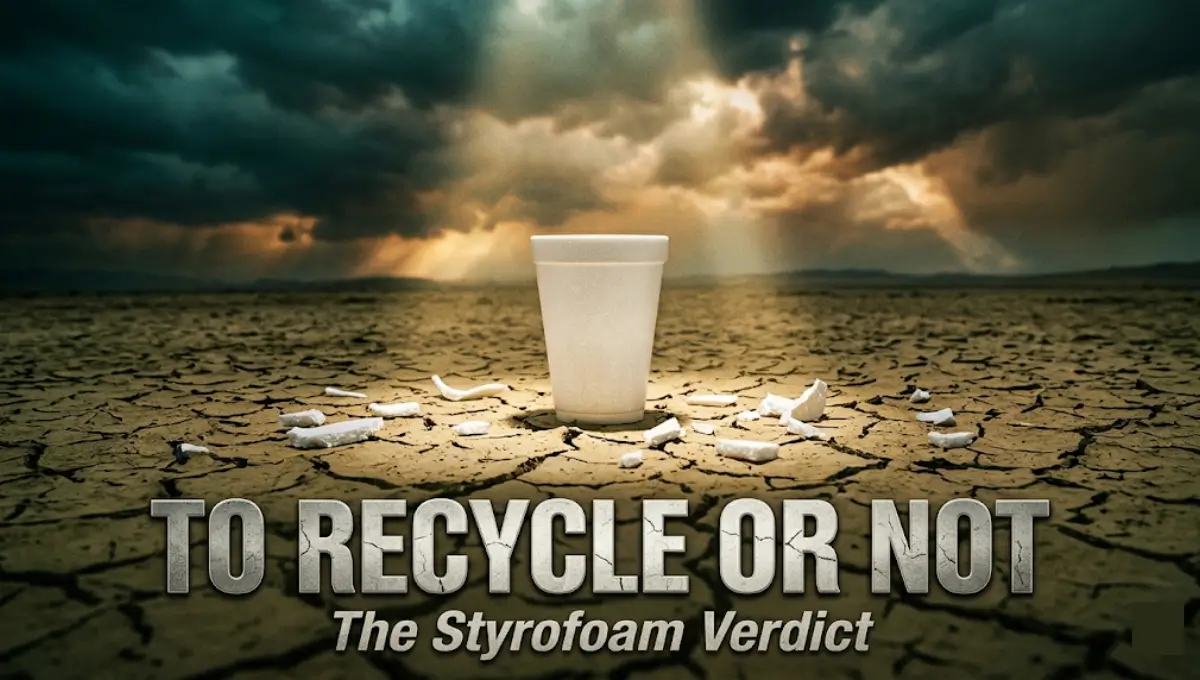
Styrofoam can be recycled — but not through your regular curbside bin. Most municipalities do not accept Expanded Polystyrene (EPS) in standard recycling programs, so it must be taken to a specialized drop-off facility.
The good news: hundreds of drop-off locations exist across the U.S., and the recycling infrastructure is slowly growing.
Quick Summary:
- Styrofoam (EPS #6 plastic) is technically recyclable but rejected by nearly all curbside programs
- Only clean, white, rigid EPS foam is accepted at specialized drop-off locations
- The #6 recycling symbol on foam does NOT mean your local program accepts it
- Food-soiled, colored, or flexible foam generally cannot be recycled at any facility
- At least 12 U.S. states have banned EPS foodservice containers as of 2026
- Use Earth911.com to find a foam drop-off location near you
Clear Answer: Can You Recycle Styrofoam?
Yes — but only at specialized facilities, not in your curbside bin.
The U.S. Environmental Protection Agency (EPA) states clearly that very few localities accept Styrofoam in curbside recycling and directs consumers to find drop-off locations via Earth911. Placing foam in a standard recycling bin contaminates other recyclables — paper, cardboard, and aluminum — and can cause an entire batch to be rejected and sent to landfill.
Source: U.S. EPA — How Do I Recycle Common Recyclables
Key Facts About Styrofoam Recycling
What is Styrofoam?
“Styrofoam” is a registered trademark of Dow Chemical, but the term is widely used for Expanded Polystyrene (EPS) — a lightweight plastic made of roughly 95% air by volume. It carries the Resin Code #6 under the standard plastics identification system. Its high air content is exactly what makes it so expensive and difficult to transport and process for recycling.
How widespread is foam recycling? The Polystyrene Recycling Alliance (PSRA) and Resource Recycling Systems (RRS) published an End Markets Study in February 2026 identifying 81 companies handling recovered EPS and XPS foam, operating 119 facilities across 30 U.S. states. Despite this, EPS drop-off access currently reaches only approximately 3% of the U.S. population, according to environmental groups. An estimated 105 million Americans have access to some form of polystyrene recycling service, but most of this is commercial, not household.
Source: Polystyrene Recycling Alliance (PSRA) / Plastics Industry Association
Why don’t more programs accept it? A 2024 study in ChemSusChem found that processing polystyrene costs approximately $1,456 per metric ton — more than most other plastics — making it economically unviable for municipal programs without grants or guaranteed supply chains. Since EPS is 95% air, haulers spend the same fuel and labor cost to collect foam that weighs almost nothing compared to glass or metal.
What happens after recycling? When EPS foam is successfully recycled, it goes through a densification process: air is removed by a machine called a densifier, compressing the foam into dense bricks or ingots. These bricks are transported to manufacturers and melted into polystyrene pellets used to make:
- Insulation materials for buildings
- Picture frames and crown molding
- Park benches and outdoor furniture
- Protective padding in sports helmets and car seats
- New EPS packaging and coolers
Note: Recycled polystyrene foam cannot be used for new food-contact applications.
Source: Foam Recycling Coalition — recyclefoam.org
Types and Categories of Foam
Not all foam is the same, and this matters for recycling.
EPS (Expanded Polystyrene) — the most recyclable type White, rigid foam used in electronics packaging, appliance packaging, egg cartons, meat trays, and shipping coolers. This is what most drop-off programs accept, provided it is clean.
GPPS / HIPS (Hard Polystyrene) Found in refrigerator parts, appliances, utensils, and blender housings. Fewer than 45 companies in the U.S. and Canada handle this material — making it even harder to recycle than standard EPS.
Flexible / Soft Foam Foam padding, mattress foam, and some packing peanuts. These require an entirely separate and rarer recycling stream.
EPS Foodservice Containers Coffee cups, takeout boxes, and foam plates. These are now banned outright in at least 12 states and three territories (see below), and even where legal, they typically cannot be recycled without industrial cleaning.
What Is Allowed vs. Not Allowed
What CAN Be Recycled (at specialized drop-off facilities)
- Clean, white, rigid EPS packaging foam (marked #6) — such as electronics and appliance packaging
- Clean foam shipping coolers, free of food residue
- Clean EPS egg cartons and meat trays (if clean and dry)
- Foam packing peanuts — many UPS Store locations accept clean packing peanuts for reuse
What CANNOT Be Recycled in Standard or Most Specialty Programs
- Colored or dyed EPS — dye contaminates the recycling process
- Food-soiled foam containers — takeout boxes, coffee cups with residue
- Soft or flexible foam — packing padding, mattress foam, foam noodles
- EPS placed in curbside bins — not accepted in virtually any U.S. municipality; causes contamination
- GPPS / HIPS hard polystyrene — appliances and utensils; fewer than 45 U.S./Canada facilities handle it
- EPS foodservice ware in ban states — now illegal in 12+ states and 3 territories
Source: U.S. EPA Recycling Guide | Earth911
Best Practices: How to Recycle Styrofoam
Step 1 — Check local acceptance first. Always verify with your local municipality or waste provider before assuming EPS is accepted. The recycling #6 symbol does not mean your local program accepts it.
Source: Earth911.com
Step 2 — Find a drop-off location. Enter “Styrofoam” or “EPS foam” and your ZIP code at Earth911.com to find nearby facilities. The Foam Recycling Coalition at recyclefoam.org also lists grant-funded drop-off programs. Dart Container Corporation offers drop-off locations for foam cups and containers in select areas.
Step 3 — Prepare the foam correctly. Remove all tape, labels, and stickers. Clean off all food residue — foam must be clean and dry. Separate EPS from flexible foam or other plastics. Do not crush or shred the foam before drop-off; facilities handle this step themselves. Avoid colored foam — most facilities only accept white EPS.
Step 4 — Consider mail-in options. TerraCycle’s “Styrofoam Zero Waste Box” is a mail-in option that accepts EPS food packaging, though the smallest box starts at approximately $107.
Source: TerraCycle — Styrofoam Zero Waste Box
Step 5 — Reuse or reduce where possible. Reuse foam peanuts — shipping companies and UPS Store locations often accept clean ones. Repurpose foam for garden use, art projects, or as a base for plant pots. Switch to alternatives such as paper bags, molded pulp packaging, compostable containers, or reusable cups.
U.S. State EPS Bans (2020–2026)
As of April 2026, at least 12 U.S. states and 3 territories have enacted bans on EPS foodservice containers. These bans reflect the recycling system’s failure to achieve viable EPS recovery rates at the consumer level.
| State / Territory | Effective Date | Key Provision |
|---|---|---|
| Maryland | October 1, 2020 | First statewide EPS foodware ban in the U.S. |
| Maine & Vermont | July 1, 2021 | EPS foodservice containers banned |
| New York | January 2022 | Nation’s strongest statewide EPS ban |
| New Jersey | May 2022 (extended to May 2026) | EPS food containers |
| Colorado | January 1, 2024 | EPS foodware ban |
| Washington | June 1, 2024 | Foam foodware, coolers, and packing peanuts |
| California | January 1, 2025 | Triggered by EPS failing to reach 25% recycling rate |
| Oregon | January 1, 2025 | EPS foodware, coolers, packing peanuts |
| Delaware | July 1, 2025 | EPS food/beverage containers |
| Rhode Island & Hawaii | January 1, 2025 | EPS foodware bans |
| Virginia | July 2025 (large vendors) / July 2026 (small vendors) | Phased ban on EPS containers |
| New York (expanded) | January 1, 2026 | Extended to cold storage EPS and packing peanuts |
A federal “Farewell to Foam Act” has been introduced in U.S. Congress to ban EPS nationwide, but as of April 2026 it has not been passed.
Globally, the EU banned foam food containers in 2021. Canada banned EPS foodservice ware in 2022. Over 97% of Australians live in an area with an EPS ban.
Source: CalRecycle — California EPS Ban | Washington State EPS Packaging Laws | Plastics Industry Association / PSRA
Common Mistakes and Misconceptions
“The #6 symbol means it’s recyclable in my bin.” The #6 resin code only identifies the material type — it does not indicate local program acceptance. Always check with your municipality directly.
“I can put Styrofoam in my curbside bin.” Virtually no U.S. municipalities accept EPS in curbside bins. It contaminates other recyclables and often causes an entire load to be rejected.
Source: U.S. EPA
“Chemical recycling will solve the EPS problem.” The only U.S. facility dedicated to polystyrene chemical recycling (Regenyx, Oregon) shut down in early 2024. A Natural Resources Defense Council report from March 2025 found only 8 chemical recycling facilities of any kind operating in the entire U.S., and most produce fuel oil rather than new plastic.
“Colored Styrofoam can be recycled.” Dyes contaminate the recycling stream. Colored foam is generally not accepted at any drop-off facility.
“Styrofoam breaks down over time.” EPS is non-biodegradable and can persist in the environment for hundreds of years. Over time it breaks into microplastics, not harmless materials.
Source: NRDC — Plastic Recycling Doesn’t Work and Will Never Work (March 2025)
FAQs
Q: Can I put Styrofoam in my recycling bin?
A: No. Almost no municipalities in the U.S. accept Styrofoam in curbside recycling bins. Doing so contaminates other recyclables. Bring it to a designated drop-off location instead.
Q: Where can I find a Styrofoam recycling drop-off near me?
A: Search by ZIP code at Earth911.com using the term “EPS foam” or “Styrofoam.” The Foam Recycling Coalition at recyclefoam.org also lists funded drop-off programs.
Q: Can foam coffee cups and takeout containers be recycled?
A: Generally, no — food-soiled EPS is rejected by most facilities, and EPS foodware is now outright banned in at least 12 states. Even in states where it is still legal, these items are rarely accepted for recycling.
Q: Is Styrofoam recyclable if it has a #6 symbol?
A: The #6 symbol tells you what material it is made from, not whether your local program accepts it. Most do not. You must verify locally and find a specialized facility.
Q: What states have banned Styrofoam?
A: As of April 2026, at least 12 states have active bans: Maryland, Maine, Vermont, New York, New Jersey, Colorado, Washington, California, Oregon, Delaware, Rhode Island, Hawaii, and Virginia (phased). Three U.S. territories also have bans.
Conclusion
Styrofoam can technically be recycled — but only clean, white, rigid EPS (#6) foam brought to a specialized drop-off location. It cannot go in your curbside bin, and it cannot be soiled, colored, or flexible. The recycling infrastructure for EPS foam is growing slowly, but access remains limited for most households. Meanwhile, a growing number of U.S. states are simply banning EPS foodservice containers altogether, reflecting the practical challenges of recycling this material at scale.
Your best actions today:
- Search Earth911.com for a drop-off near you
- Never put foam in your curbside bin
- Reduce foam use by choosing compostable or reusable alternatives where possible
Confirmed Source URLs
- U.S. EPA Recycling Guide: https://www.epa.gov/recycle/how-do-i-recycle-common-recyclables
- Earth911 Recycling Locator: https://earth911.com
- Foam Recycling Coalition: https://www.recyclefoam.org
- Polystyrene Recycling Alliance (PSRA): https://www.plasticsindustry.org/PSRA
- TerraCycle Styrofoam Zero Waste Box: https://www.terracycle.com
- CalRecycle (California EPS Ban): https://calrecycle.ca.gov
- NRDC Report on Chemical Recycling (March 2025): https://www.nrdc.org
- Washington State Ecology Department: https://ecology.wa.gov