Last updated: April 2026 | Sources: U.S. EPA, AF&PA, Republic Services, Rumpke, ecomaine
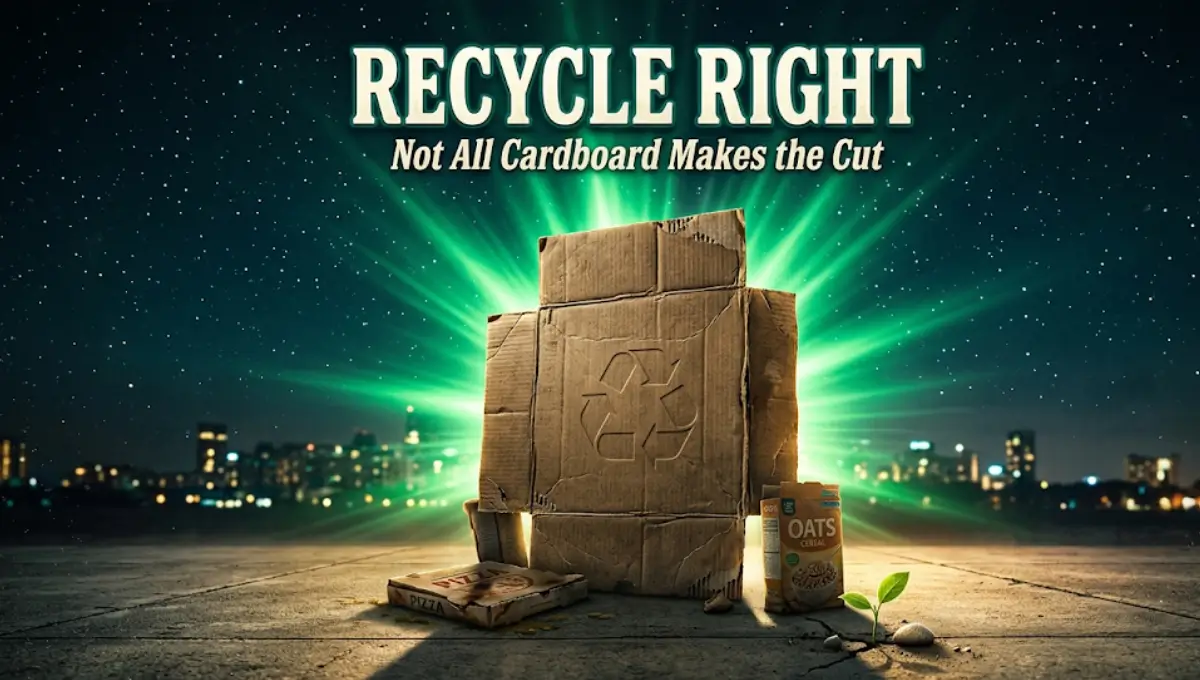
You’ve got a pile of flattened Amazon boxes by the door. A greasy pizza box on the counter. A cereal box with the plastic liner still inside.
Which ones go in the recycling bin — and which ones secretly belong in the trash?
Cardboard is one of the most recycled materials on earth, but a surprising number of people get it wrong.
Not all cardboard is created equal, and one contaminated item can ruin an entire truckload of otherwise good recyclables.
This guide cuts through the confusion with verified facts from official sources — so you can recycle smarter, not harder.
The Short Answer
Yes — cardboard can and should be recycled. In 2024, over 33 million tons of cardboard were recycled in the United States alone, hitting a national recycling rate of 69–74% (roughly 90,000 tons per day).
But recyclability depends on three things: the type of cardboard, its cleanliness, and the rules of your local program.
Key Facts & Environmental Impact
Recycling one ton of cardboard delivers measurable environmental benefits:
| Benefit | Value per Ton Recycled |
|---|---|
| Trees saved | 17 trees |
| Energy saved | ~5,000 kWh (64–75% less than virgin production) |
| Water saved | 7,000 gallons |
| Oil saved | 46 gallons |
| CO₂ reduction | ~403.5 kg |
| Landfill space saved | 9 cubic yards |
| Air pollution reduction | 73% less vs. manufacturing from raw wood pulp |
Sources: U.S. EPA, Republic Services, Challenge Packaging
When cardboard goes to landfill instead of being recycled, it decomposes anaerobically and releases methane — a greenhouse gas significantly more potent than CO₂.
Recycling isn’t just good practice; it’s genuinely impactful at scale.
Types of Cardboard: What’s Accepted
✅ Corrugated Cardboard
The most common shipping material — three layers with a wavy middle. It is the single most recycled packaging type on the planet.
- Shipping and moving boxes
- Product packaging boxes
- Delivery cartons
✅ Paperboard (Cartonboard)
Single-ply, thicker paper material used for consumer goods packaging.
- Cereal boxes (remove plastic liner first)
- Shoe boxes
- Cosmetics packaging
- Pharmaceutical boxes
✅ Chipboard
Made from compressed recycled paper.
- Backs of notepads
- Gift boxes
- Puzzle boards
✅ Other Accepted Forms
- Brown paper bags
- Toilet paper and paper towel rolls
- Egg cartons (when clean)
- Envelopes and file folders
- Greeting cards
Source: U.S. EPA — How Do I Recycle Common Recyclables
What Cannot Be Recycled
❌ Wax-Coated or Plastic-Lined Cardboard
Wax and polyethylene coatings do not dissolve during the pulping process and contaminate the entire batch.
- Frozen food boxes with plastic lining
- Waxed produce crates
- Juice and milk cartons with plastic laminates
❌ Heavily Food-Contaminated Cardboard
Grease and oil interfere with the pulping process — floating on the pulp slurry and preventing paper fibers from separating properly. A single saturated item can ruin an entire load of recyclables.
❌ Wet or Mold-Damaged Cardboard
Moisture destroys paper fibers. Mold spreads to other items in the recycling bin and lowers their quality. If it got rained on, it goes in the trash.
❌ Cardboard with Foil, Glitter, or Plastic Laminate
Common in luxury gift boxes. The metallic or textured coating cannot be processed with standard cardboard.
❌ Soiled Paper Plates and Coated To-Go Cups
These are specifically listed as unacceptable by major waste management companies.
Sources: Earth911, Republic Services, U.S. EPA
The Pizza Box Question (Definitive Answer)
Pizza box recycling is one of the most misunderstood recycling questions. The answer genuinely varies by facility:
| Source | Position |
|---|---|
| U.S. EPA | Pizza boxes can be recycled, even with grease. Remove food scraps, flatten, and place in bin. |
| AF&PA (industry body) | Grease in typical pizza box amounts is not an issue for paper mills. Remove leftover pizza and recycle. |
| Republic Services | Heavily soiled boxes are not accepted — grease and food chunks contaminate other recyclables. Tear the clean lid off and recycle it separately. |
| Rumpke | Accepts greasy pizza boxes regardless of grease level; their mill partners do not consider grease a contaminant. Frozen pizza boxes also accepted once plastic wrap is removed. |
Practical Rule of Thumb
- Lightly greasy box → Accepted by most programs. Remove food bits and flatten.
- Heavily soiled box (pooled oil, stuck-on cheese) → Remove food, tear off and recycle the clean lid, compost or bin the greasy bottom.
- Frozen pizza box → Generally recyclable after removing plastic wrap.
- When in doubt → Check your local program’s specific guidelines.
Sources: U.S. EPA, AF&PA, Republic Services, Rumpke
Best Practices: How to Prepare Cardboard for Recycling
Follow these steps before putting cardboard in the bin:
- Remove all contents — Take out bubble wrap, packing peanuts, foam inserts, and any non-cardboard packing materials.
- Remove food and liquid — The benchmark is “spatula-clean”: free enough of residue that a spatula could scrape it. Light grease is generally fine; soaked cardboard is not.
- Remove or minimize tape — Small amounts are acceptable (recycling facilities filter it out). Peel off large strips of plastic tape.
- Flatten all boxes — Break down and flatten every box. Cut oversized pieces to no larger than approximately 2 feet × 2 feet. Un-flattened boxes waste space and reduce recycling efficiency.
- Keep it dry — Only put cardboard out on dry days, or store it in a covered area. Never recycle wet or moldy cardboard.
- Remove plastic liners — Cereal boxes and similar packaging contain a separate plastic bag inside. Remove and discard this before recycling the box.
- Check your local rules — Guidelines vary widely between municipalities. When in doubt, check your local waste management program’s website.
Sources: U.S. EPA, Republic Services, ecomaine
Common Mistakes to Avoid
✗ Wish-Cycling (Aspirational Recycling)
Placing non-recyclable items in the bin hoping they’ll be accepted — coated boxes, waxed cartons, heavily soiled cardboard. They won’t be. And they may contaminate good recyclables around them.
✗ Leaving Boxes Three-Dimensional
Un-flattened boxes take up excessive space in bins and trucks, reducing recycling efficiency and capacity.
✗ Putting Recyclables in Plastic Bags
Plastic bags jam sorting equipment and create hazards for facility workers. Always place cardboard loose in the bin.
✗ Recycling Wet or Rained-On Cardboard
Wet cardboard cannot be processed. Moisture destroys the paper fibers that make recycling possible.
✗ Not Removing Plastic Liners
The plastic bag inside cereal boxes must be removed before the box is recycled. The box yes; the liner no.
✗ Recycling Coated Cardboard as Regular Cardboard
Wax- or plastic-coated boxes contaminate standard cardboard batches and require separate, specialized processing.
Sources: ecomaine — 10 Common Recycling Mistakes, Republic Services, U.S. EPA
FAQs
Q: Can I recycle a pizza box?
Usually yes, if it’s only lightly greasy. Remove food scraps and flatten it. For heavily soiled boxes, tear off the clean lid to recycle and trash or compost the greasy bottom. Always check your local program’s rules to be certain.
Q: Does cardboard need to be perfectly clean to be recycled?
No. The standard is “spatula-clean” — free enough of residue that a spatula could scrape it away. Light grease is generally acceptable; cardboard soaked in oil or food is not.
Q: Can I leave tape and staples on boxes?
Small amounts of tape are fine — recycling facilities have equipment to filter it out. Remove large strips of plastic tape if possible. Staples are generally acceptable and are separated magnetically during processing.
Q: Can frozen food boxes be recycled?
It depends on the coating. If the box is lined with plastic, it cannot go in standard cardboard recycling. Plain frozen food boxes without coating are generally accepted once dry, empty, and any plastic liner removed.
Q: What happens if I recycle contaminated cardboard?
A single heavily contaminated item can cause an entire batch of recyclables to be sent to landfill. This is why it’s better to trash a borderline item than risk ruining a good load.
Recent Updates (2024–2026)
United States — May 2025
The American Forest & Paper Association (AF&PA) and Fibre Box Association (FBA) published an updated Voluntary Standard for Repulping and Recycling Coated or Treated Corrugated Fiberboard — the first major revision since 2013. The updated standard provides industry-tested protocols to determine whether coated or treated cardboard packaging is repulpable and recyclable, helping manufacturers design packaging that can re-enter the recycling stream.
Source: AF&PA — Updated Voluntary Standard, May 2025
United Kingdom — March 2025
The UK Department for Environment, Food & Rural Affairs (Defra) introduced Simpler Recycling regulations, effective 31 March 2025, requiring all workplaces to separate paper and cardboard into their own collection stream. Non-compliance is reportable to the Environment Agency. Micro-enterprises have until 31 March 2027 to comply.
Conclusion
Cardboard recycling is one of the most impactful and accessible things you can do for the environment — but only when done right. The key takeaways:
- Most cardboard is recyclable — corrugated boxes, paperboard, chipboard, and more.
- Cleanliness matters — light grease is usually fine; soaked or moldy cardboard is not.
- Always flatten — it’s one of the simplest ways to make recycling more efficient.
- Remove plastic liners — the box yes, the bag inside it no.
- When in doubt, check local rules — what’s accepted varies by municipality and facility.
Recycling one ton of cardboard saves 17 trees, 7,000 gallons of water, and 5,000 kWh of energy. The effort it takes to flatten a box and pull out a plastic liner is small. The cumulative impact is not.
Confirmed Sources
| Source | URL |
|---|---|
| U.S. EPA — How Do I Recycle Common Recyclables | https://www.epa.gov/recycle/how-do-i-recycle-common-recyclables |
| U.S. EPA — Paper and Paperboard Material-Specific Data | https://www.epa.gov/facts-and-figures-about-materials-waste-and-recycling/paper-and-paperboard-material-specific-data |
| AF&PA — Pizza Boxes Are Recyclable | https://www.afandpa.org/news/2023/lets-set-record-straight-pizza-boxes-are-recyclable |
| AF&PA — 2024 Cardboard Recycling Statistics | https://www.afandpa.org/news/2025/how-much-cardboard-recycled |
| AF&PA & FBA — Updated Voluntary Standard, May 2025 | https://www.afandpa.org/news/2025/industry-publishes-updated-voluntary-standard-recycling-cardboard |
| Republic Services — Cardboard Recycling | https://www.republicservices.com/residents/recycling-and-solid-waste/cardboard |
| Republic Services — Pizza Boxes & Recycling Myths | https://www.republicservices.com/blog/pizza-boxes-and-other-recycling-myths |
| Rumpke — Are Pizza Boxes Recyclable? (Updated Jan 2026) | https://www.rumpke.com/blog/are-pizza-boxes-recyclable |
| ecomaine — 10 Common Recycling Mistakes (2024) | https://www.ecomaine.org/about-ecomaine/news/2024/10/10-common-recycling-mistakes/ |
| Earth911 — How to Recycle Waxed Cardboard (Updated 2024) | https://earth911.com/recycling-guide/how-to-recycle-waxed-cardboard/ |
Report compiled April 2026. All data sourced from U.S. government agencies (EPA), major waste management companies (Republic Services, Rumpke), leading industry associations (AF&PA, FBA), and sustainability organizations.